
How Token Exchange Simplifies IAM Migrations
When an organisation moves from a legacy IAM platform to a modern, future‑proof system, one of the biggest challenges is handling the tokens used across the application landscape. The moment the new IAM system starts issuing its own token format, you effectively create two identity domains inside your organisation:
Legacy domain — applications still using the old token type
Target domain — applications migrated to the new IAM system
Every application now lives in one domain or the other, and migrating them becomes a multi‑step, multi‑team effort. For organisations with dozens or hundreds of interconnected systems, this quickly becomes complex. Coordinating deployment schedules, sequencing dependencies, or attempting “big bang” migrations across entire value streams introduces significant risk — especially when systems cut across multiple domains or teams.
Enabling Cross‑Domain Communication
A migration becomes far easier when applications can temporarily communicate across the domain boundary. If an application can call both legacy and target‑state systems without losing access to critical dependencies, teams can migrate independently and at their own pace. This reduces central coordination, lowers risk, and allows hundreds or even thousands of applications to move in parallel.
One effective way to enable this is through OAuth Token Exchange (RFC 8693).
With token exchange, an authorisation server accepts one type of token and returns another — all in a single API call. In a multi‑domain migration, this means:
A legacy token can be exchanged for a target token
A target token can be exchanged for a legacy token
This gives applications a safe, controlled way to cross the domain boundary.
Example: An Application Needing Both Token Types
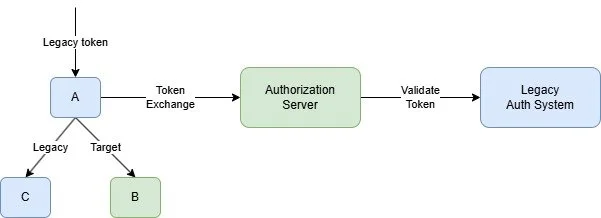
Token exchange legacy to target
Imagine Application A still receives a legacy token, but it needs to call:
Application B → requires a target token
Application C → still requires a legacy token
Application A can use token exchange to convert its legacy token into a target token. It now holds both token types and can call both systems without waiting for either dependency to migrate.
In some cases, Application B could perform the exchange instead. There is no universal right answer — the best approach depends on system capabilities, integration patterns, and team priorities.
After Migration: Reversing the Direction
As the migration progresses, the situation changes. Suppose Application A and its downstream systems have now moved to the target domain. Application A now receives a target token, but it still needs to call Application C, which expects a legacy token.
In this case, Application A simply switches to exchanging target → legacy.
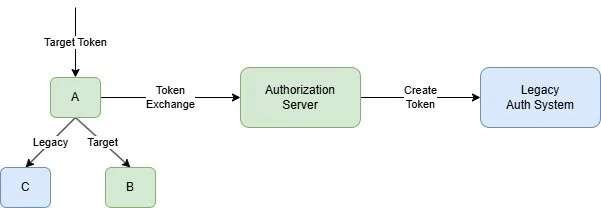
This flexibility allows each application to migrate whenever it is ready, without breaking existing integrations.
Token Exchange as a Transitional Architecture
It’s important to emphasise that token exchange belongs firmly in the transition architecture, not the target state. Its usage should rise during the early phases of migration and naturally decline as more systems adopt the new IAM platform. Eventually, when no systems require legacy tokens, the exchange service can be decommissioned.
Governance, Access Control, and Monitoring
A key architectural decision is whether the token exchange should be openly accessible or tightly controlled. With proper onboarding, access control, and monitoring, the exchange can become a powerful tool for the IAM team.
It can provide insights such as:
Which applications still rely on legacy tokens
Which teams are lagging behind in migration
Unexpected token flows or misaligned integration chains
Real‑world migrations are messy. You may discover that the legacy IAM system has stopped issuing tokens entirely — yet some applications are still exchanging target → legacy → target because of outdated integration chains. With good visibility into token exchange usage, you can identify these systems, contact the responsible teams, and help them complete their migration.
Key Takeaways
Introducing a new IAM system creates two token domains — legacy and target — which complicates application migrations.
Cross‑domain communication is essential to avoid tightly coupled migration schedules and reduce risk.
OAuth Token Exchange (RFC 8693) provides a clean, standardised way to convert tokens between domains.
Applications can migrate independently by exchanging tokens as needed, without breaking downstream integrations.
Token exchange is a transitional tool, not part of the long‑term target architecture.
Monitoring token exchange usage gives IAM teams valuable insight into migration progress and misaligned systems.
Need Help With Your IAM Migration?
If your organisation is planning or executing an IAM migration and you want expert guidance on architecture, token strategies, or migration planning, feel free to contact us. We’re happy to help you design a smooth and secure transition.